Please Stop Helping Us_How Liberals Make It Harder for Blacks to Succeed by Jason L. Riley
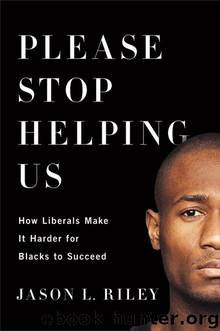
Author:Jason L. Riley [Riley, Jason L.]
Language: eng
Format: epub
Tags: Politics, Non-Fiction, Sociology
ISBN: 1594037256
Google: XUDrAgAAQBAJ
Amazon: B00IQY3EZK
Barnesnoble: B00IQY3EZK
Goodreads: 18406408
Publisher: Encounter Books
Published: 2013-10-09T20:00:00+00:00
If anything, minimum-wage policies have become less and less effective over time as an antipoverty tool, according to Cornell University economists Richard Burkhauser and Joseph Sabia. In 1939, the year the federal minimum was established, 94 percent of household heads who were low-wage workers were in poor families, along with 85 percent of all low-wage workers. By 1969 those figures were 45 percent and 23 percent, respectively. By 2003 they were 11 percent and 9 percent.
“We find no evidence that minimum wage increases between 2003 and 2007 lowered state poverty rates. Moreover, we find that the newly proposed federal minimum wage increase from $7.25 to $9.50 per hour, like the last increase from $5.15 to $7.25 per hour, is not well targeted to the working poor,” wrote Burkhauser and Sabia in a 2010 paper.
Only 11.3% of workers who will gain from an increase in the federal minimum wage to $9.50 per hour live in poor households, an even smaller share than was the case with the last federal minimum wage increase (15.8%). Of those who will gain, 63.2% are second or third earners living in households with incomes twice the poverty line, and 42.3% live in households with incomes three times the poverty line, well above $50,233, the income of the median household in 2007.
Liberals bleat on about raising the federal floor to help the working poor, but most poor people already make more than the minimum, and most people who earn the minimum wage aren’t poor.
With all due respect to the late Ted Kennedy, the best antipoverty program is not the minimum wage. Rather, it’s a job, even if it’s an entry-level one. Most poor families don’t have any workers. Raising the minimum wage does nothing for them, and to the extent that it reduces their employment opportunities, it’s a net negative. Reducing the number of entry-level jobs keeps people poor by limiting their ability to enter or remain in the workforce, where they have the opportunity to obtain the skills necessary to increase their productivity and pay, and ultimately improve their lives.
Unions support minimum wages not because they want to help the working poor but because they want to protect their members, who already have jobs. “Just as businesses seek to have government impose tariffs on imported goods that compete with their products, so labor unions use minimum wage laws as tariffs to force up the price of non-union labor that competes with their members for jobs,” wrote Thomas Sowell in Basic Economics.24 What’s painful is watching black leaders align themselves with unions that are working against the interests of low-income blacks who are out of work. Walmart, for example, has a history of locating its stores in less affluent neighborhoods and providing those residents with not only jobs but low-cost goods and services. The political left claims to care so much more than conservatives about the well-being of the poor. But labor unions and Democratic politicians from Obama on down would rather have these ghetto residents stay
Download
This site does not store any files on its server. We only index and link to content provided by other sites. Please contact the content providers to delete copyright contents if any and email us, we'll remove relevant links or contents immediately.
The Brazilian Economy since the Great Financial Crisis of 20072008 by Philip Arestis Carolina Troncoso Baltar & Daniela Magalhães Prates(360807)
International Integration of the Brazilian Economy by Elias C. Grivoyannis(111585)
The Art of Coaching by Elena Aguilar(53639)
Flexible Working by Dale Gemma;(23354)
How to Stop Living Paycheck to Paycheck by Avery Breyer(19833)
Thinking, Fast and Slow by Kahneman Daniel(12520)
The Acquirer's Multiple: How the Billionaire Contrarians of Deep Value Beat the Market by Tobias Carlisle(12427)
The Radium Girls by Kate Moore(12177)
The Art of Thinking Clearly by Rolf Dobelli(10709)
Hit Refresh by Satya Nadella(9247)
The Compound Effect by Darren Hardy(9144)
Tools of Titans by Timothy Ferriss(8589)
Atomic Habits: Tiny Changes, Remarkable Results by James Clear(8512)
Turbulence by E. J. Noyes(8199)
A Court of Wings and Ruin by Sarah J. Maas(8101)
Change Your Questions, Change Your Life by Marilee Adams(7927)
Nudge - Improving Decisions about Health, Wealth, and Happiness by Thaler Sunstein(7849)
How to Be a Bawse: A Guide to Conquering Life by Lilly Singh(7612)
Win Bigly by Scott Adams(7333)
